How to Choose Demolition Attachments for Excavators?
Choosing Demolition Attachments For Excavators is not simply a matter of selecting the largest breaker or the heaviest shear. The correct attachment must match the excavator’s operating weight, hydraulic flow, material type, and working space. A tool that looks powerful on paper may perform poorly on a compact machine. It may also create unnecessary vibration, slow production, or increase maintenance costs.
Demolition consultant Mike Taylor has said, “The best attachment is the one that matches the machine, the material, and the work sequence.” That principle remains practical on real job sites. Concrete thickness, reinforcement density, access limits, and debris handling can change the decision completely. A hydraulic breaker may suit reinforced slabs, while a pulverizer can improve separation and reduce transport volume. Shears often provide cleaner cutting around steel structures. But no attachment is perfect.
Small errors matter. Operators should check carrier compatibility, hydraulic pressure, flow requirements, pin dimensions, and approved lifting limits before work begins. Manufacturer specifications are useful, but field experience still matters. Dust, hidden steel, uneven ground, and restricted visibility can expose weaknesses that brochures do not mention. This guide examines those details and compares attachment choices by application, productivity, safety, and long-term value. It also acknowledges an uncomfortable truth: the cheapest attachment may become the most expensive choice when downtime, repairs, and poor material processing are included. Careful selection reduces that risk, although it cannot remove every uncertainty.
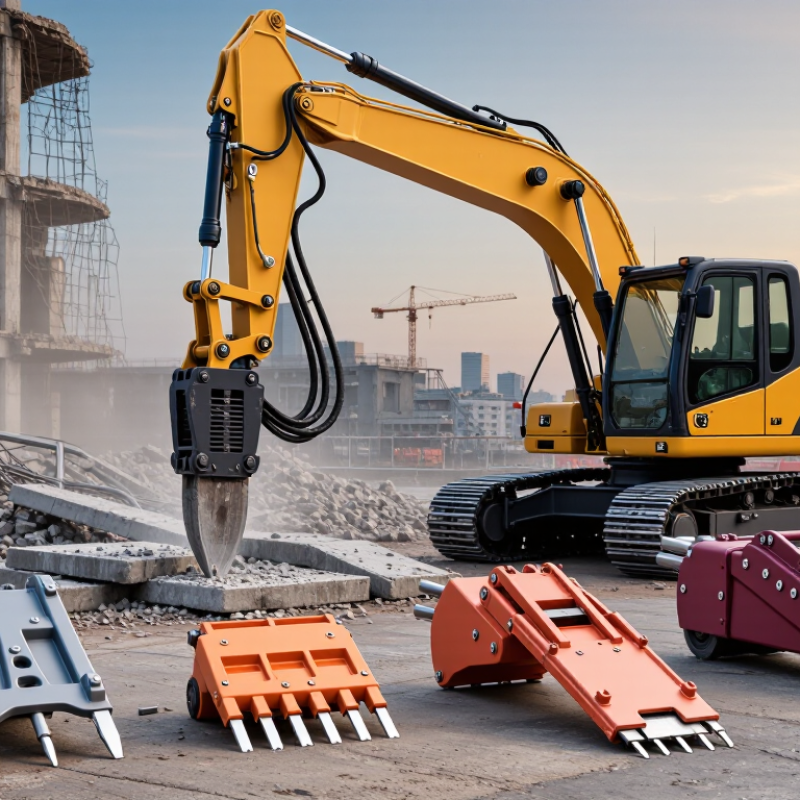
Understanding Excavator Demolition Attachments and Their Main Uses
How to Choose Demolition Attachments for Excavators?
Understanding each attachment’s main use makes demolition work safer and more productive.
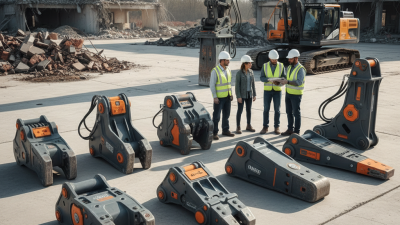
A hydraulic breaker suits reinforced concrete, foundations, and thick masonry. Its performance depends on impact energy, excavator weight, and hydraulic flow.
For separating steel from concrete, a hydraulic shear offers controlled cutting and better material sorting.
A pulverizer crushes concrete into smaller pieces, reducing loading space and improving recycling efficiency.
Grapples handle loose debris, timber, and irregular materials with useful precision.
Attachment choice should match the structure, work sequence, and excavator’s lifting capacity. Check hydraulic pressure, flow rate, mounting dimensions, and approved operating limits before installation.
A quick coupler can save time, but poor locking procedures create serious risks. Visibility also matters, especially near unstable walls. Dust suppression, vibration control, and regular pin inspection deserve attention.
A common mistake is choosing the largest attachment available. Bigger is not always better. Excessive weight can reduce stability and damage the carrier.
Tips:
Inspect the attachment daily. Confirm every connection. Keep bystanders outside the work zone. Use the correct tool for each material. Track wear on cutting edges, teeth, hoses, and bushes.
Real site conditions may differ from planning drawings, so operators should reassess the structure continuously. Even experienced teams can overlook hidden voids, embedded steel, or uneven ground. Careful observation often prevents expensive adjustments later.
Assessing Demolition Requirements Before Choosing an Attachment
Choosing a demolition attachment starts with understanding the structure, not the excavator. Identify the material, thickness, reinforcement, and connection points. Concrete walls behave differently from steel frames or masonry partitions. A quick visual guess can be wrong.
Measure the work area carefully. Check the required reach, working height, access width, and ground conditions. Then compare these findings with the excavator’s operating weight, hydraulic flow, pressure, and lifting capacity. An attachment that is too heavy can reduce stability. One with insufficient power may cause slow, uneven work. Also inspect nearby utilities, occupied areas, dust exposure, and falling-debris risks. A qualified engineer or site supervisor should verify uncertain structural details. Practical judgment matters, but it should not replace documented checks.
Tips: Match the attachment to the hardest material expected, not the easiest section. Confirm jaw opening, tool weight, rotation needs, and service access. Ask whether water suppression or dust collection is required. Keep a clear exclusion zone. Small planning errors become expensive delays.
Some choices need reconsideration. For example, a compact attachment may improve access but require more passes. A larger tool may finish faster but overload the carrier or limit visibility. Review the demolition sequence before ordering equipment. Record site measurements, machine specifications, and trial results. This creates a more reliable decision than relying on habit alone.
Attachment selection should begin with the demolition requirement. Hydraulic breakers are generally suited to reinforced and unreinforced concrete, pulverizers are effective for secondary concrete reduction and rebar separation, shears are designed for structural steel, and grapples support material handling and sorting. The scores represent practical suitability on a 1–5 scale, where 5 indicates the strongest fit.
Selecting the Best Demolition Attachment for Cost and Project Efficiency
How to Choose Demolition Attachments for Excavators?
Selecting the right demolition attachment controls cost, output, and site safety. Start with the excavator’s operating weight, hydraulic flow, pressure, and lifting capacity. A breaker that exceeds the carrier’s limits may increase wear and downtime. A weak attachment wastes fuel and operator hours. The U.S. EPA estimated 600 million tons of construction and demolition debris were generated in 2018. Better attachment selection can support faster separation and recycling on busy sites (U.S. EPA, Sustainable Management of Construction and Demolition Materials, 2020).
Match the tool to the material and work sequence. A pulverizer suits concrete reduction, while a shear supports controlled steel cutting. A multi-processor may reduce attachment changes, but its purchase and maintenance costs can be higher. Measure cycle time, daily output, fuel use, and service intervals. These figures create a practical cost-per-ton comparison. Do not trust catalogue productivity alone. Actual results change with operator skill, rebar density, access, and weather. That gap deserves attention.
Tips: Check hydraulic compatibility before price. Request tested output data. Inspect mounting pins, hoses, and jaws. Keep one spare wear component on site. The best choice is not always the cheapest. For smaller projects, renting may protect cash flow and reduce storage costs. For frequent demolition, ownership can offer better availability, but only when utilization is high enough. The right decision may still look imperfect after the first project. Review the numbers, then adjust.
How to Choose Demolition Attachments for Excavators? - Selecting the Best Demolition Attachment for Cost and Project Efficiency
| Attachment Type |
Best Primary Use |
Typical Excavator Class
(metric tons) |
Typical Attachment Weight
(metric tons) |
Typical Hydraulic Flow
(L/min) |
Typical Planning Output
(t/h) |
Material Separation Quality |
Relative Operating Cost |
Key Selection Consideration |
| Hydraulic Breaker |
Breaking concrete slabs, foundations, masonry and rock |
10–45 |
0.5–4.0 |
50–300 |
5–30 |
Low |
Medium |
Match tool size to concrete thickness, required impact energy and the excavator’s auxiliary-flow capacity. |
| Hydraulic Pulverizer |
Secondary reduction of concrete and removal of rebar |
15–45 |
1.0–3.5 |
100–250 |
8–25 |
High |
Low–Medium |
A strong choice when clean concrete and steel separation reduces hauling, landfill and recycling charges. |
| Hydraulic Shear |
Cutting structural steel, pipe, tanks and heavy reinforcement |
20–60 |
1.5–6.0 |
150–350 |
5–20 |
High for steel |
Medium–High |
Verify jaw opening, cutting force, reach and machine stability before selecting a heavy shear. |
| Hydraulic Grapple |
Sorting, loading and handling mixed demolition debris |
8–40 |
0.4–2.5 |
60–180 |
15–50 |
High for sorting |
Low |
Prioritize tine shape, rotation control, shell capacity and visibility when material handling is the main task. |
| Hydraulic Drum Cutter |
Controlled cutting of concrete, rock, tunnels and sensitive structures |
8–45 |
0.7–3.5 |
80–250 |
5–20 |
Medium–High |
High |
Use when low vibration, controlled profiles or reduced noise are more important than maximum demolition speed. |
| Tiltrotator-Compatible Sorting Tool |
Precise picking, trimming and selective dismantling |
6–25 |
0.3–1.5 |
40–140 |
10–35 |
High for selective work |
Low–Medium |
Best suited to confined sites where positioning accuracy and reduced machine repositioning improve productivity. |
Project-Based Selection Guide
| Project Requirement |
Recommended Attachment Priority |
Main Efficiency Goal |
Cost-Control Action |
| Large reinforced-concrete structure |
Breaker for primary reduction, followed by pulverizer |
Fast breakdown and clean recycling streams |
Avoid using a breaker for all secondary sizing; pulverizing can reduce sorting and disposal work. |
| Steel-frame or industrial dismantling |
Hydraulic shear with grapple support |
Controlled cutting and safe material handling |
Select sufficient jaw capacity and avoid oversizing, which increases carrier requirements and fuel use. |
| Mixed debris recovery and recycling |
Rotating grapple or sorting grapple |
Higher material recovery and fewer truck movements |
Match grapple volume to the excavator’s lift capacity and the truck-loading cycle. |
| Work near occupied buildings or utilities |
Pulverizer, grapple or drum cutter |
Low vibration, noise and collateral damage |
Consider total project cost rather than attachment price alone, including monitoring and protection measures. |
| Confined or urban site |
Compact breaker, grapple or tiltrotator-compatible tool |
Reduced repositioning and improved access |
Check tail swing, working radius, attachment width and transport limitations before purchase or rental. |
Planning note: The capacity, flow, weight and output figures are typical planning ranges for commonly used excavator demolition attachments. Actual performance varies with excavator hydraulic pressure, material strength, operator skill, attachment condition, work height, debris size, site access and truck cycle time. Confirm the attachment manufacturer’s specifications and the excavator’s approved auxiliary hydraulic limits before operation.